
Research · · verified August 31, 2026
Does a Stable Publishing Cutoff Improve Offshore Research Handoffs?
A measurement design for testing cutoff stability, late evidence, and review quality in a daily article routine.
Research question
Does a stable publishing cutoff improve the quality of handoffs between an offshore researcher, writer, and accountable editor? A deadline alone cannot answer this. A rigid cutoff may stop useful evidence from entering the article, while a movable cutoff can leave the reviewer with no dependable window for checking claims and rendered output.
The testable issue for Offshore Resourcing is stability. When the cutoff changes, why did it change, how late did evidence arrive, and what review work was compressed or repeated? Those observations can show whether the routine protects a real decision window or merely displays a time on a calendar.
Scope and method
This article develops a prospective measurement design from public material on working time, fatigue, internal control, content management, service operations, and research planning. The sources describe principles and findings in their own settings. They do not establish an ideal cutoff for offshore publishing, and we do not infer one.
For four weeks, the team can observe article packages scheduled through the same routine. Before work begins, record the research handoff time, editorial cutoff, release owner, minimum review checks, and rule for late evidence. After each package closes, record changes, causes, and review consequences. Compare stable days with changed-cutoff days descriptively. The sample is too small for a universal causal claim, but it can expose the team's own failure modes.
Define the three times separately
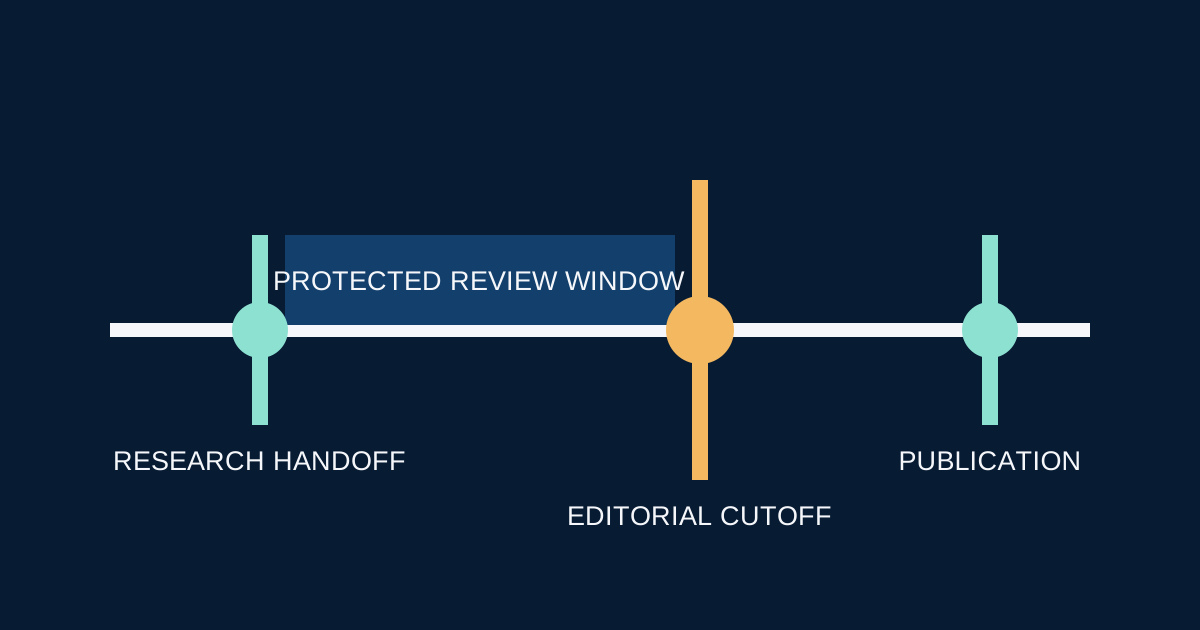
Research handoff, editorial cutoff, and publication time are not synonyms. Research handoff is when the evidence packet becomes ready for drafting or review. Editorial cutoff is the last planned point for material changes before the release owner makes a decision. Publication time is when the article becomes public. Combining them hides where delay entered the workflow.
Each time also needs an owner. The researcher can declare the evidence packet complete within the brief, but cannot necessarily authorize publication. The editor can close normal changes, while a publisher may still stop release for a material problem. A coordinator can maintain the schedule without owning factual or legal judgment.
What to record when the cutoff moves
Record the original cutoff, revised cutoff, time of change, person authorizing it, and reason. Reasons may include late material evidence, source access failure, scope change, reviewer capacity, technical failure, or an upstream approval delay. The categories should be few enough to use consistently but specific enough to suggest a remedy.
The team should also record what happened to review. Did the editor repeat source checks after new wording arrived? Was accessibility review completed? Did structured metadata change? Was the rendered page checked after the final edit? A moved cutoff is not inherently a defect. The concern is whether its consequence remains visible.
Late evidence needs a decision rule
Evidence discovered after the cutoff should not enter automatically and should not be ignored automatically. The release owner needs a rule based on materiality. A source that corrects a central claim may require reopening the article or postponing publication. A minor supporting example may wait for a documented update. A source that does not meet the brief's standards should be rejected even if it arrives early.
The offshore researcher can summarize the new evidence, identify affected claims, and state why it may be material. The editor decides the copy impact. Specialists retain decisions in regulated or sensitive domains. This division keeps urgency from shifting authority to whoever happens to be online.
Measures that reveal stability
The first measure is the percentage of packages whose editorial cutoff changed. The second is median change notice, measured between authorization and the original cutoff. The third is the share of changed packages that required a repeated review step. A fourth, qualitative measure records which minimum checks were shortened, skipped, or moved after publication.
These measures need context. A low change rate can be bad if contributors ignore late corrections. A high rate can be appropriate during a breaking event or a new workflow. The analysis should pair counts with reasons and outcomes. It should never assume that publishing on time is more important than correcting a material error.
Looking for patterns, not blame
Plot cutoff changes by cause and stage. Repeated late source access may indicate that credentials or approved databases are not ready at intake. Recurring scope changes may show that the brief is approved too early. Reviewer-capacity changes may point to too many simultaneous packages. Technical failures belong to a different owner than editorial ambiguity.
Do not rank individual researchers by handoff time without accounting for assignment complexity and source availability. The aim is to test the routine. If contributors fear recording a late issue, the apparent schedule may improve while the evidence quality declines.
What the sources support
The International Labour Organization and World Health Organization have published evidence about long working hours and health. NIOSH publishes material on work schedules and fatigue. GAO's Green Book addresses defined responsibility, quality information, and monitoring. GOV.UK guidance covers research planning and content management. These sources support attention to workload, decisions, and controlled information in their own contexts.
Our analysis is narrower: a predictable review window may help a distributed publishing team coordinate checks, but only a local observation can show whether a particular cutoff is stable or useful. The cited evidence does not prove that one time of day, overlap period, or staffing model will improve article quality.
Review design and safeguards
Agree on definitions before observation begins. Use system timestamps where they already exist, but do not expand employee monitoring merely to run the study. Keep notes about workflow events, not personal activity. Review the findings with representatives of research, writing, editing, and coordination because each role sees a different part of the handoff.
At the end of the observation period, choose one repair tied to the strongest pattern. Examples might include earlier source-access checks, a clearer late-evidence rule, or a protected render-review window. Run the same measures again. Changing several controls at once makes the result difficult to interpret.
Limitations
A four-week observation is vulnerable to unusual workload, holidays, topic mix, and staffing changes. Teams may behave differently when they know timing is being observed. Review quality is also harder to measure than completed checkboxes. A completed source check can still be weak.
The method cannot establish that cutoff stability causes better articles. It can show association, sequence, and repeated operational causes. It also cannot set employment schedules or determine lawful working arrangements. Those decisions require appropriate local expertise and worker consultation.
Evidence-led conclusion
A stable editorial cutoff is useful only if it protects a defined review window and a material-evidence rule. Teams can test that function by separating research handoff, editorial cutoff, and publication time, then recording changes, authorization, causes, and repeated or compressed checks. The resulting evidence can guide a local routine repair. It does not support a universal cutoff hour, a worker speed target, or publication at the expense of a material correction.
Sources
- ILO: working time and work-life balance around the world
- WHO and ILO: long working hours and health
- CDC NIOSH: work schedules
- GAO Green Book
- GOV.UK: plan user research for your service
- GOV.UK: managing content
- U.S. Plain Language Guidelines
- ISO quality management principles
- NIST Cybersecurity Framework 2.0
- W3C Web Content Accessibility Guidelines 2.2
Related Research
What Editorial Decisions Disappear When Review Comments Are Resolved?
A qualitative study design for preserving decision evidence without turning article review into permanent transcript storage.
Testing Reproducibility in Offshore Access Reviews
A bounded research design for examining access-review reproducibility in distributed operations without overstating causal evidence.
Observing Completeness in Offshore Work Intake
A bounded research design for examining intake completeness in distributed operations without overstating causal evidence.