
Research · · verified August 31, 2026
What Editorial Decisions Disappear When Review Comments Are Resolved?
A qualitative study design for preserving decision evidence without turning article review into permanent transcript storage.
The question hidden inside a clean draft
What editorial decisions disappear when a distributed team resolves comments and keeps only the final article? A clean document is useful for publication, but cleanliness can remove the reason a claim was narrowed, a source was rejected, or a section was excluded. The next offshore researcher may encounter the same question and repeat the entire debate.
Keeping every comment forever is not a sound answer. Review threads may contain personal data, informal speculation, inaccessible shorthand, or information that should never enter a broad archive. Offshore Resourcing needs a narrower question: which decisions must survive the review thread so that recurring article work remains explainable and safe to hand over?
How this research frames the problem
This article draws on public guidance about records, decisions, content management, plain language, accessibility, and internal control. The evidence does not establish how often editorial teams lose decisions. Instead, it helps define a qualitative sample study and a minimal decision record.
The proposed study selects recently published articles with substantial review activity. An authorized reviewer compares the resolved comments with the final draft and notes which comments contained a reusable decision. No private comments should be copied into a new system merely for research. The team should work within its existing retention, access, legal, and privacy rules.
A comment is not automatically a decision
Most review comments are local. They fix wording, request a citation, or point out a formatting error. Once the article changes, the final text supplies enough evidence. A reusable decision is different. It affects future work, establishes a boundary, or explains why plausible wording was rejected.
Examples include a ruling that a source population does not match the site's audience, a decision that a role may collect evidence but not interpret a regulated rule, or an instruction to omit a comparison because its definitions cannot be reconciled. If that reasoning exists only in a resolved thread, a later contributor sees the result but not the constraint.
Sampling resolved threads
Begin with a small, bounded sample across different article types and reviewers. For each resolved thread, ask four questions. Did it change a material claim? Did it establish a rule likely to recur? Would the final article reveal the reason? Would preserving the decision create a privacy, security, or access problem? These questions separate reusable evidence from conversational residue.
Record categories rather than reviewer performance. Useful categories include source suitability, claim scope, audience boundary, role authority, legal or specialist escalation, accessibility, and publication timing. The study should also record "final text sufficient" when no separate decision record is needed. That category prevents the exercise from treating every edit as institutional knowledge.
What the final article cannot show
Final copy usually shows what the team approved, not the alternatives it rejected. This is often desirable. Readers do not need an internal debate attached to every sentence. The operating risk appears when a future contributor needs to understand a repeatable boundary and cannot reconstruct it from public copy or an approved policy.
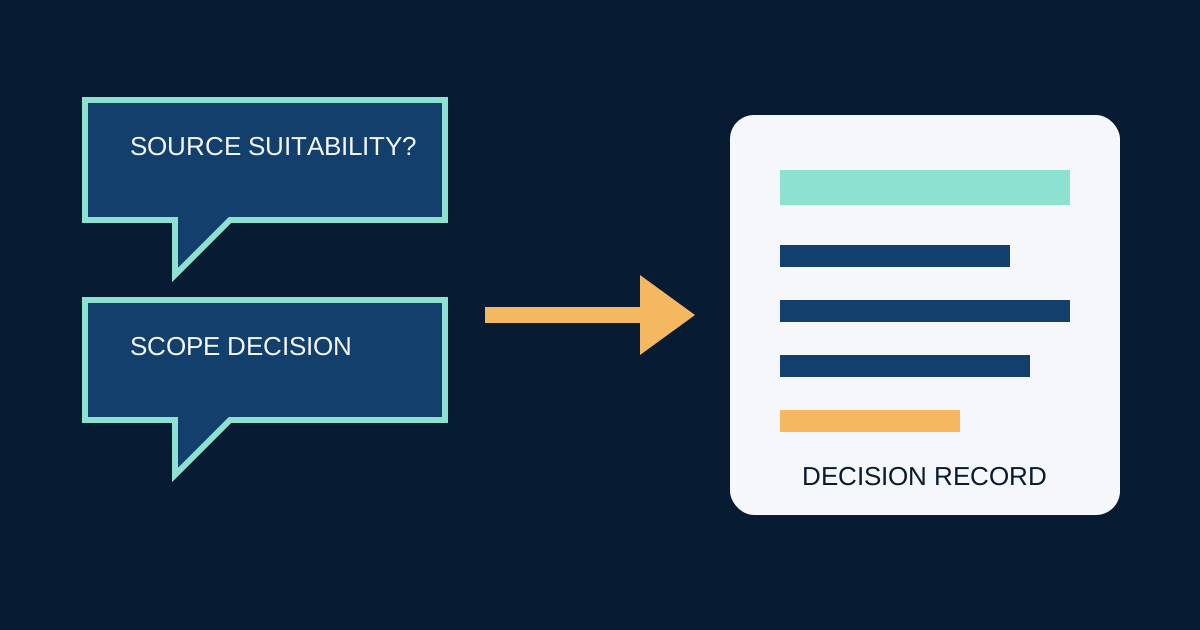
Consider a reviewer who removes a paragraph based on a vendor survey because the sample covers a different industry. The final article simply lacks the paragraph. Six weeks later, another researcher finds the same survey and proposes the same claim. A short decision record could prevent duplicate work: source rejected for this use because population did not match the article question. It need not preserve the whole discussion.
The minimum decision record
A compact record needs the decision, date, decision owner, affected article or rule, reason, supporting evidence, scope, and review date if the decision may expire. The reason should be written for someone who was not in the conversation. Links should point to material the intended reviewer can access. Sensitive evidence should remain in its authorized system.
The record should not quote every participant or reproduce brainstorms. It should not identify a person as the cause of a mistake when the useful information is the decision itself. It should not convert an editor's one-off preference into a permanent company rule. The decision owner must state whether the record applies to one article, a topic family, or the operating routine.
Who owns preservation
The person resolving a comment can flag that it contains a reusable decision, but the editor or process owner should approve the durable record. An offshore coordinator can maintain the register and link records to briefs. The coordinator should not decide that a legal interpretation, security exception, or employment rule applies broadly.
Managers also need a deletion path. A superseded decision should be marked as such and linked to its replacement. A record that no longer has a valid purpose should follow the organization's retention rules. "Keep everything" creates a larger access surface and makes it harder to find the decisions that matter.
How to interpret the sample
The first result should be descriptive. Report how many sampled threads contained a reusable decision, which categories appeared, and how often final copy was sufficient. Review a few classifications with a second person to see whether the definition is stable. Disagreement is useful because it exposes categories that are too vague.
Do not use the study to score editors by comment count or to conclude that more retained decisions mean better work. A mature brief may prevent long threads. A difficult article may require many. The measure concerns recoverability of operating knowledge, not the volume of visible activity.
Source-backed principles and our analysis
The National Archives and ISO publish records and quality-management guidance. GAO's internal-control standards address documentation, quality information, and responsibility. GOV.UK guidance discusses managing content, user needs, and clear writing. W3C supplies accessibility requirements for understandable content. These are facts about the cited guidance.
Our analysis is that editorial teams can apply these principles through selective decision capture. The cited sources do not mandate an editorial comment register, prescribe its fields, or prove that it reduces rework in offshore teams. That distinction matters because a sensible control can still create unnecessary administration if applied without a defined purpose.
Limitations and risks
The sample may miss decisions made in calls or private messages. Reviewers may classify the same comment differently. Historical comments can include information that current researchers should not access. Tool behavior also varies: some systems retain resolved threads, while others make retrieval difficult.
The method cannot recover a decision that was never written down. It can also encourage over-retention if managers treat every comment as evidence. Before sampling, define access, retention, and redaction rules with the appropriate owners. Stop if the study would expose material beyond the reviewer's authority.
Evidence-led conclusion
Resolved comments create decision loss when they contain a recurring source, scope, audience, or authority ruling that the final article cannot explain. A selective sample can find those cases without preserving entire conversations. The evidence supports a minimal record approved by the decision owner, with clear scope and retention. It does not support permanent storage of every review thread or employee scoring based on comment activity.
Sources
Related Research
Does a Stable Publishing Cutoff Improve Offshore Research Handoffs?
A measurement design for testing cutoff stability, late evidence, and review quality in a daily article routine.
Testing Reproducibility in Offshore Access Reviews
A bounded research design for examining access-review reproducibility in distributed operations without overstating causal evidence.
Observing Completeness in Offshore Work Intake
A bounded research design for examining intake completeness in distributed operations without overstating causal evidence.