
Research · · verified August 31, 2026
How Much Search Time Does an Ambiguous Offshore Research Brief Create?
A field-ready method for separating useful discovery from avoidable search caused by unclear article briefs.
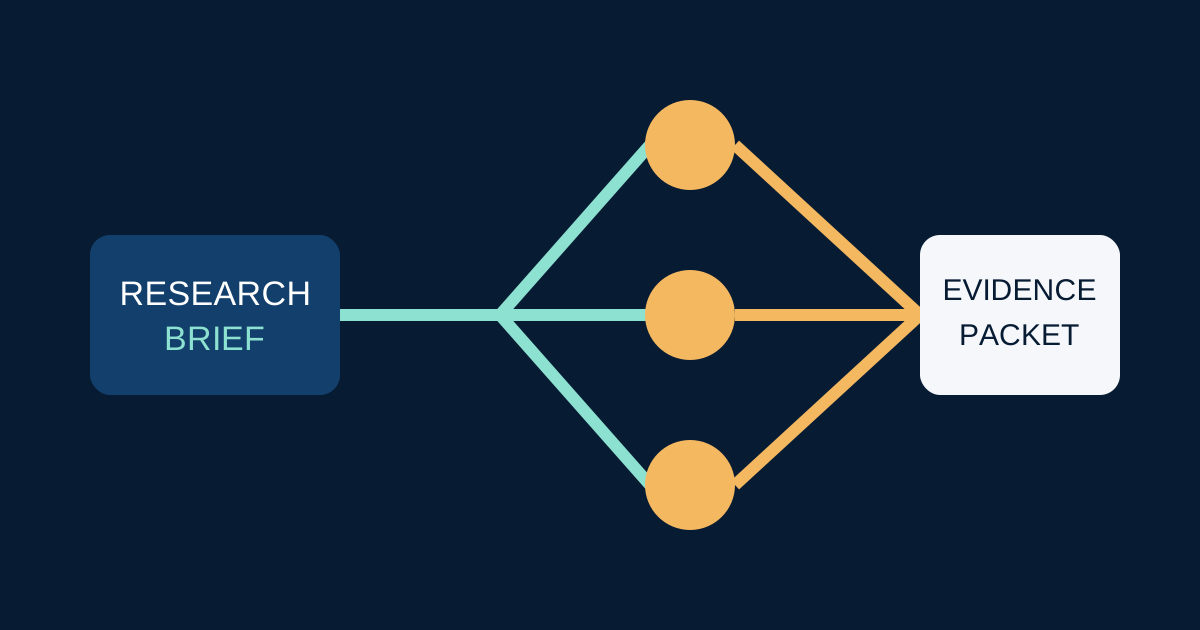
Research question
How much of an offshore researcher's search time comes from legitimate discovery, and how much comes from ambiguity in the article brief? A manager cannot answer that question by looking at hours alone. Two assignments may each take four hours while producing very different evidence. One researcher may test a precise question across several source types. Another may spend the same period guessing what the requested audience, jurisdiction, or decision was supposed to be.
This distinction matters for Offshore Resourcing because recurring article work depends on a usable handoff. A brief that contains a topic but no decision can send a distributed contributor through a wide search with no defensible stopping point. The operating problem is not whether research should be fast. It is whether the team can identify search that the brief itself caused and repair the input before the pattern repeats.
Evidence scope and method
This analysis combines public guidance on research planning, plain language, information quality, internal control, and content design. The sources do not measure offshore article teams as a single population. They supply principles that can be translated into an observation method: define the question, record assumptions, preserve the search trail, and compare the finished evidence with the original request.
The proposed measure is a small operational study rather than a market benchmark. Select a run of comparable research briefs, record clarification events and search pivots, then classify why each pivot occurred. The unit of analysis is one article assignment. Facts drawn directly from the sources are identified as such. The classification rules and management uses are our analysis.
What counts as brief-caused search
Search is brief-caused when the researcher must make a material choice that an accountable owner should have made before the assignment began. Common examples include selecting the reader, choosing between countries, deciding whether a claim concerns candidates or employees, or inventing the time period for a comparison. Normal discovery is different. It tests the stated question, finds evidence that changes an assumption, or reveals a limitation that could not reasonably have been known at intake.
The line is not always obvious. A precise brief can still meet conflicting evidence. An open research question can intentionally allow exploration. The record therefore needs the reason for each pivot, not just a count. A note such as "changed query" says little. A note such as "brief named no jurisdiction; results described incompatible employment systems" gives a reviewer enough context to decide whether the input was defective.
A practical observation record
The researcher can keep a light record while working. It should capture the initial question, intended reader decision, required scope, first search terms, material pivots, clarification requests, and the point at which enough evidence existed to draft. This is not a minute-by-minute surveillance log. It is a record of changes in direction that affected the evidence set.
For each material pivot, use one of four causes: evidence discovery, source failure, brief ambiguity, or owner-directed change. Evidence discovery means the research properly changed direction after learning something. Source failure covers inaccessible, obsolete, or methodologically unsuitable material. Brief ambiguity means a missing definition forced a choice. Owner-directed change records a new instruction after work began. These causes have different remedies, so combining them under "research took longer" hides useful information.
Turning observations into a measure
A team can report the share of material pivots attributed to brief ambiguity and the elapsed time between a clarification request and its answer. It can also compare planned questions with final claims. These measures do not prove individual productivity. They show where the operating system placed uncertainty.
Time estimates should remain ranges. Reconstructing exact minutes from browser history creates false precision, while asking contributors to run detailed timers can change how they work. A simple band, such as under 15 minutes, 15 to 45 minutes, or more than 45 minutes, is often enough to locate repeated waste. The useful result is a pattern: several briefs may omit the same population, definition, approval owner, or source boundary.
Facts, analysis, and the manager's decision
GOV.UK research guidance says teams should agree research questions and turn unfounded assumptions into questions. Its content guidance assigns content designers responsibility for accurate, relevant, accessible writing based on user needs. GAO internal-control guidance treats quality information and defined responsibility as parts of effective operations. The U.S. plain-language guidance also supports stating material in the order readers need it. Those are source-backed principles.
Our analysis is that an offshore article brief should bind those principles to a concrete decision packet. The packet should name the audience, decision, scope, exclusions, evidence standard, and person who can resolve uncertainty. The publisher owns those choices. The offshore researcher can flag a gap, show its consequence, and propose a narrow clarification. The contributor should not silently choose a jurisdiction or convert an exploratory question into a confident conclusion.
What a brief repair looks like
Suppose a request says, "research remote support productivity." The phrase does not state the type of support, unit of output, quality threshold, workforce relationship, country, period, or intended reader decision. A researcher could find a large volume of credible material and still deliver the wrong article. The repaired brief might ask how a manager can measure completion and error rates for a recurring inbox-triage role during its first 30 days, while excluding compensation and legal claims.
That revision narrows the search without preselecting the answer. It identifies the workflow, measures, period, and exclusions. It still permits the evidence to show that completion and error rates are insufficient. Good constraints reduce arbitrary choice; they do not manufacture a finding.
Role boundaries and review use
The researcher owns the search record and should surface ambiguity when it changes the evidence. The editor owns the public claim and decides whether the available evidence answers the intended question. The hiring or operations manager owns the role scope. A legal, security, clinical, or financial specialist owns interpretations in those domains. Offshore research support should not absorb those decision rights merely because it is closest to the draft.
Reviewers should sample a few high-pivot and low-pivot briefs, inspect the records, and ask whether the classification is reproducible. If reviewers disagree about the cause, refine the definitions before using the measure. Do not rank workers by raw pivot count. A diligent researcher may record more problems than a contributor who guesses silently.
Limitations
This method has not been tested as a controlled study of offshore research teams. Self-recorded pivots can be incomplete, and elapsed time includes interruptions unrelated to the brief. Complex investigative pieces will usually require more exploration than routine explainers. The cited guidance comes largely from public-sector and standards contexts, so its principles need adaptation to a private publishing workflow.
The method also cannot decide how much research an article deserves. That depends on reader risk, claim sensitivity, and the publisher's standards. It can only separate visible reasons for changing direction and show where clarification was delayed.
Evidence-led conclusion
An ambiguous brief creates measurable cost when it forces an offshore researcher to make material scope choices or wait for an owner to make them. The most defensible measure is not total hours. It is a short record of material search pivots, their causes, and clarification delay. Used across comparable assignments, that record can reveal recurring missing definitions without treating legitimate discovery as waste. The evidence supports clearer questions and responsibilities; it does not support a universal time target or an individual productivity score.
Sources
- GOV.UK: plan user research for your service
- GOV.UK: what each role does in a service team
- GOV.UK: content design
- U.S. Plain Language Guidelines
- GAO Green Book
- NIST Information Quality Standards
- W3C Web Content Accessibility Guidelines 2.2
- UK Government Service Standard
- U.S. National Archives records management guidance
- ISO quality management principles
Related Research
When Should an Offshore Researcher Record That Evidence Was Not Found?
Research on negative search evidence, stopping rules, and cautious claims in recurring article production.
What Should an Offshore Researcher Do When Sources Conflict?
Evidence-led research on source conflict, escalation, and editorial boundaries in distributed article research.
How Quickly Does Source Freshness Decay in Offshore Research Publishing?
A methodology for deciding when an offshore article source remains usable, needs rechecking, or should be retired.