
Research · · verified August 31, 2026
Can an Offshore Publishing Team Prove a Fact Correction Reached Every Draft?
Research on correction propagation, version evidence, and decision ownership in distributed article production.
Research question
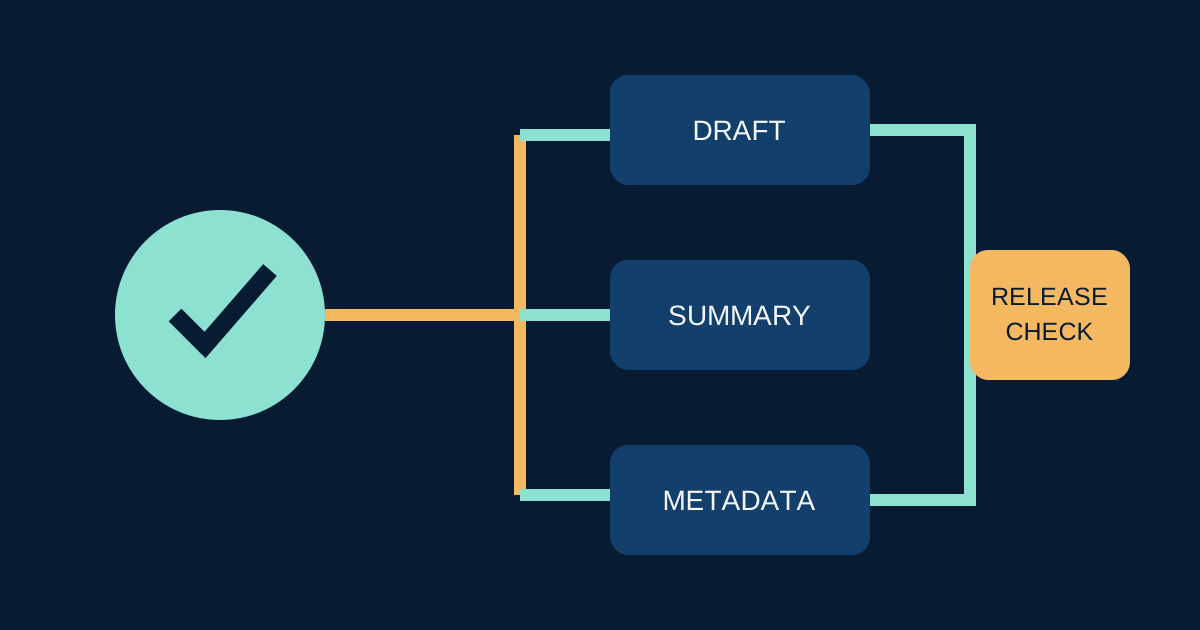
Can a distributed publishing team prove that a corrected fact reached every active draft, excerpt, and scheduled record before publication? Fixing the sentence in one document is not the same as containing the error. An offshore researcher may update a source note while a writer keeps an older outline, an editor reviews a copied draft, and a coordinator prepares metadata from yesterday's summary.
For Offshore Resourcing, this is a coordination question with an evidence trail. The goal is not to create a heavy incident system for every typo. It is to give the person accountable for publication a reliable answer when a material claim changes: where did the claim travel, which copies were checked, and who decided that the correction was complete?
Method and evidence scope
We reviewed public guidance on records, internal control, information quality, digital content, accessibility, and security incident handling. These sources address different settings. None reports a correction rate for offshore article teams. We use their common ideas, including traceability, assigned responsibility, controlled records, and verification, to construct a publishing-specific propagation test.
The test begins with a material correction in a research record and follows only the places where the affected claim may appear. It does not assume that every article needs the same process. The proposed workflow is analysis, not a sourced industry standard. Source-backed facts are limited to what the cited bodies publish about their own frameworks and guidance.
Why a corrected source note is insufficient
A claim can be copied into a brief, outline, draft, table, caption, social description, or structured metadata. It can also be paraphrased, which makes exact-text search unreliable. If the researcher edits the source note but does not identify the claim's downstream uses, the team has evidence of a correction but not evidence of propagation.
This is a version problem and an ownership problem. Version labels help only when contributors know which record controls the public copy. Ownership helps only when the owner can see the affected records. A correction protocol therefore needs both a source of truth and a bounded search for dependent material.
Start with a correction record
The correction record should state the affected claim, why it changed, the controlling source, the previous wording, the approved replacement or removal, the severity, the decision owner, and the time the correction entered the workflow. It should avoid copying restricted material that other contributors are not allowed to see. If the reason cannot be shared, the record can state the required public change and route the sensitive evidence to an authorized reviewer.
Severity should reflect reader consequence rather than embarrassment. A spelling change rarely warrants a propagation sweep. A wrong eligibility rule, safety statement, jurisdiction, date, or numerical comparison may do so. The publisher should define these categories before a deadline, because the offshore coordinator should not have to invent the threshold while chasing drafts.
Build a claim dependency list
The team does not need a map of every sentence. It needs a list for claims likely to travel. At intake, assign a short claim identifier to material facts that may be reused across the article package. Record each destination when the claim moves into a draft, data table, summary, or metadata field. When the fact changes, the identifier provides a bounded list to inspect.
This approach is more reliable than searching for one phrase. A writer may change "12 months" to "one year," or turn a source qualification into a table label. The dependency list points to the record even when wording changes. It also allows the correction owner to mark a destination as unaffected and explain why.
The propagation test
A correction passes when an authorized reviewer can start from the correction record, open every listed active destination, and confirm that the old claim is absent or clearly superseded. The reviewer should also check scheduled and cached inputs that can still publish, not only the main draft. Each destination receives a status: corrected, removed, unaffected, blocked, or retired.
"Corrected" means the approved change appears in the controlling version. "Removed" means the claim no longer appears. "Unaffected" requires a short reason. "Blocked" names the unavailable system or owner. "Retired" means the record cannot feed publication. The final sign-off belongs to the publisher or editor with release authority, not automatically to the person who discovered the error.
A worked offshore handoff
Imagine a Philippines-based research assistant finds that an official page has replaced a rule cited in an article. The assistant records the new source and flags the claim as material. The writer has a working draft, the editor has an exported review copy, and the coordinator has already written a description. The correction owner uses the dependency list to check all three.
The working draft receives revised wording and its source link. The exported copy is retired so no one can approve it. The description did not repeat the rule, so it is marked unaffected with a reason. The editor then compares the rendered preview with the record. This sequence preserves role boundaries: the assistant supplies evidence, the writer changes prose, and the editor decides whether the package can publish.
Signals that the control is failing
Repeated discovery of old claims during final review suggests that claim destinations are not being recorded. A growing number of blocked destinations may indicate excessive copying into personal documents or tools without shared access. Corrections that remain open across a handoff can reveal an unclear release owner. Frequent "unaffected" labels with no reason can show that the status is being used to close work rather than verify it.
Managers can sample material corrections and reproduce the path. They should avoid rewarding a low correction count. A team may report few corrections because it does not detect errors or because contributors fear raising them. The useful evidence is whether a known correction reached its bounded destinations before release.
Fact, analysis, and boundary
GAO's Green Book describes quality information, reporting lines, and corrective action as parts of internal control. The National Archives publishes records-management guidance, and NIST publishes frameworks for incident response and information quality. W3C accessibility guidance requires content to be understandable and robust. Those sources support disciplined information handling in their respective domains.
Our analysis applies those concepts to article correction flow. It does not claim that a publishing correction is a cybersecurity incident or a government record. It also does not turn an offshore researcher into a compliance officer. Legal notices, regulated statements, security incidents, and privacy breaches require the appropriate specialist process.
Limitations
The dependency list adds administrative work and can become stale if contributors copy material without recording it. It will not find a false claim that nobody recognizes as false. A claim identifier may be excessive for low-risk articles, and exact thresholds depend on the publisher's subject matter. Rendered platforms can also retain caches outside the editorial team's control.
This qualitative model has not been validated against a large sample of publishing incidents. It offers a reproducible control design, not a measured estimate of error reduction. Teams should test it on a small set of material claims before expanding it.
Evidence-led conclusion
An offshore publishing team can prove correction propagation only when it records where a material claim traveled and verifies each active destination against the approved correction. Editing one source note or searching one phrase does not supply that proof. A bounded dependency list, explicit destination statuses, and release-owner sign-off create a traceable answer while keeping research, writing, and publication decisions with the right roles. The method shows containment of a known correction; it cannot prove that every fact in an article is true.
Sources
- GAO Green Book
- U.S. National Archives records management
- NIST Incident Response project
- NIST Information Quality Standards
- NIST Cybersecurity Framework 2.0
- W3C Web Content Accessibility Guidelines 2.2
- GOV.UK: managing content
- U.S. Plain Language Guidelines
- ISO quality management principles
- CISA Secure by Design
Related Research
Testing Reproducibility in Offshore Access Reviews
A bounded research design for examining access-review reproducibility in distributed operations without overstating causal evidence.
Observing Completeness in Offshore Work Intake
A bounded research design for examining intake completeness in distributed operations without overstating causal evidence.
Designing a Philippines Offshore Escalation Quality Study
A bounded research design for examining escalation record quality in distributed operations without overstating causal evidence.