
Research · · verified September 8, 2026
How much clarification burden comes from an incomplete offshore content brief?
A research protocol for testing whether missing brief decisions create avoidable questions, search pivots, and article rework.
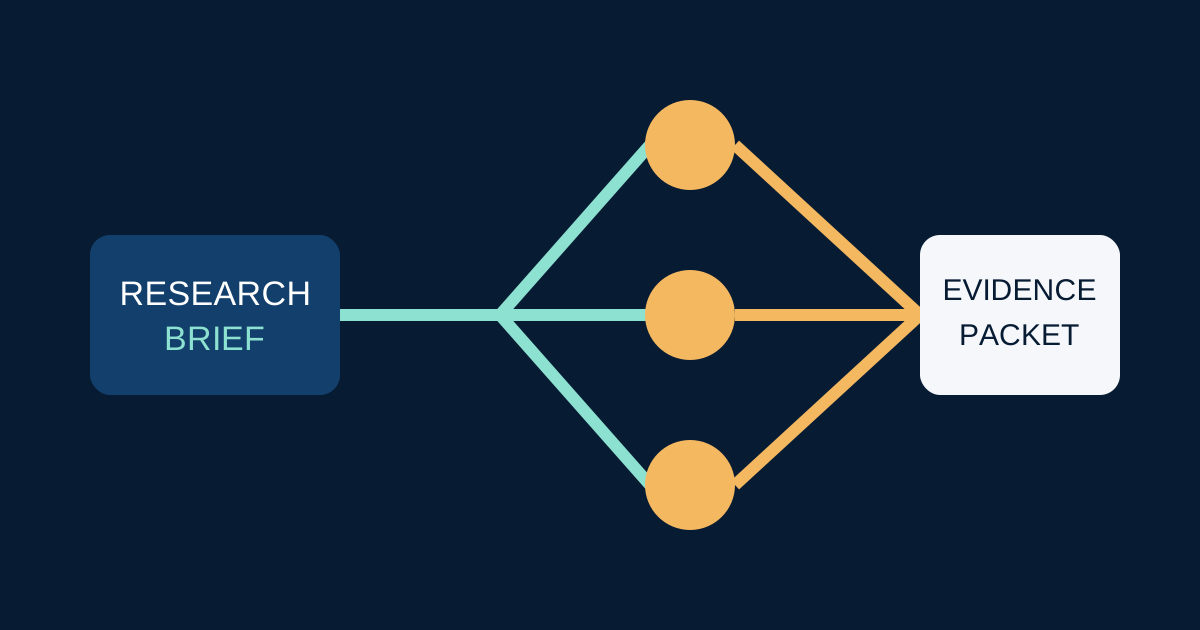
Research question
Which clarification events in recurring offshore article work could have been prevented by a more complete brief? The useful question is not whether writers ask questions. Good questions often prevent unsupported claims. The question is whether the commissioning record omitted a decision the owner already could have made.
Methodology and scope
Select comparable assignments and preserve each original brief. Record clarification questions, the missing field, response time, search or draft work affected, and whether the answer changed audience, scope, claim, or evidence requirements. Two reviewers should classify a sample independently. The assignment is the unit of analysis.
Research-planning and content-design guidance supports explicit questions, audience needs, and documented assumptions. No cited source measures this site's offshore brief burden. The classification and proposed application are our inference.
Interpretation
Distinguish legitimate discovery from preventable ambiguity. Conflicting evidence discovered during research is not necessarily a bad brief. Missing jurisdiction, intended reader, approval owner, or claim threshold often is. Count questions alongside their material effect rather than rewarding silence.
Limitations
Chat records may miss verbal clarifications. Writers differ in how readily they surface uncertainty. Reviewer classification can be subjective, and a changed business priority can resemble an incomplete original brief. The study cannot establish a universal cost per question.
Conclusion
Use the result to repair repeatable input fields, not to discourage questions. A successful brief reduces owner-resolvable ambiguity while preserving escalation for evidence conflicts and newly discovered limits.
Sources
- GOV.UK Service Manual: planning user research
- GOV.UK content design guidance
- U.S. Digital.gov plain language
- U.S. GAO Green Book
- CDC Program Evaluation Framework
- ISO quality management principles
- NIST Engineering Statistics Handbook
- Pew Research Center methods
- Google Search Central: helpful content
- W3C Web Content Accessibility Guidelines
Related Research
Testing Reproducibility in Offshore Access Reviews
A bounded research design for examining access-review reproducibility in distributed operations without overstating causal evidence.
Observing Completeness in Offshore Work Intake
A bounded research design for examining intake completeness in distributed operations without overstating causal evidence.
Designing a Philippines Offshore Escalation Quality Study
A bounded research design for examining escalation record quality in distributed operations without overstating causal evidence.